
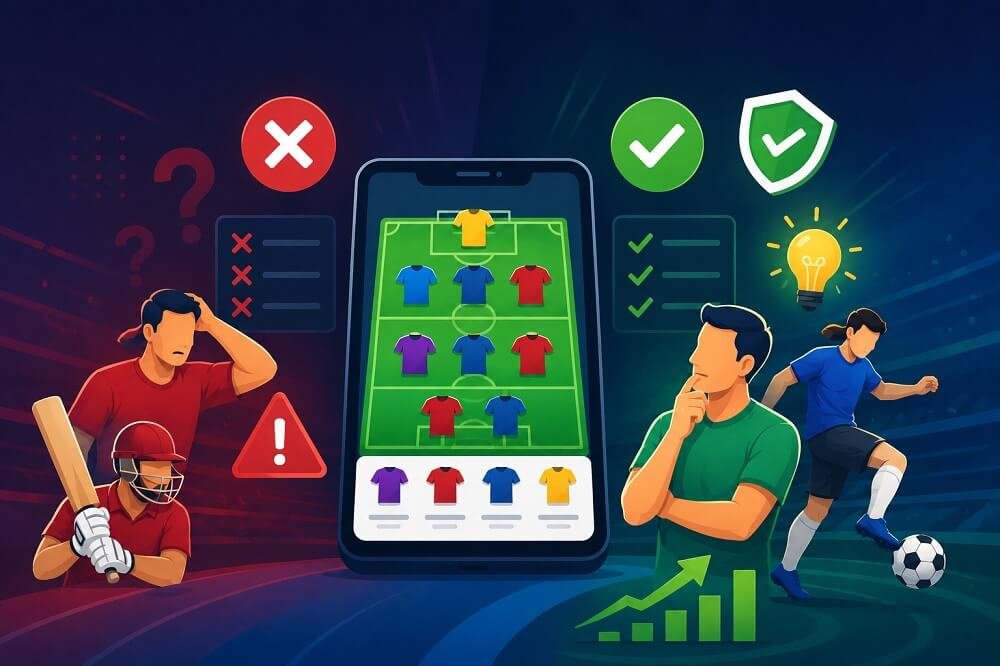
Fantasy sports can make watching a real sporting event more interactive. You study athletes, create a virtual lineup, follow live statistics, and see how real performances affect fantasy points.
The basic concept is easy to understand.
Making consistent team-selection decisions is more difficult.
Beginners often assume that poor fantasy results happen because they selected the “wrong” player. In reality, the bigger issue may be the process used to build the team.
Perhaps the scoring system was not fully understood. Maybe an unavailable player remained in the lineup. A famous athlete might have been selected without checking their current role. Sometimes a last-minute social media post causes a user to change several carefully researched selections.
These are common fantasy sports mistakes, and many can be reduced with a better research routine.
No strategy can guarantee a particular fantasy result. Real sporting performances remain unpredictable. However, understanding frequent lineup and research errors can help beginners make more informed decisions.
This guide covers some of the most common fantasy sports mistakes and practical ways to avoid them in 2026.
Why Do Beginners Make Fantasy Sports Mistakes?
Most beginners do not make poor decisions intentionally.
Fantasy games can display a large amount of information at once. You may see player prices or virtual credits, recent points, selection percentages, positions, match details, and captain options.
At the same time, sports websites and social media are publishing predictions, injury discussions, expected lineups, and player recommendations.
The amount of information can become overwhelming.
As a result, beginners often use shortcuts.
They choose familiar names. They copy another lineup. They select the previous match’s highest scorer. They make decisions based on one statistic because analyzing everything feels complicated.
A better approach is to simplify the process.
Understand the scoring system, check participation, study current player roles, compare player performance, and review reliable sporting information with play99exch to make more informed fantasy sports decisions.
A clear process can help reduce avoidable fantasy mistakes.
Mistake 1: Ignoring the Fantasy Scoring System
One of the biggest fantasy sports mistakes is selecting players before understanding how points are awarded.
Fantasy games do not necessarily use identical scoring rules.
Even games based on the same sport may calculate fantasy points differently.
Suppose you are comparing two athletes. One produces highly visible attacking statistics, while the other contributes across several less obvious categories.
Without understanding the scoring system, you may automatically choose the first player.
However, the game’s rules might reward several types of contributions.
How to avoid this mistake
Read the official scoring rules before starting player research.
Identify which actions earn points, which actions may lead to deductions, and whether the format includes bonuses or multipliers.
If captain and vice-captain features are available, understand their scoring effects.
Your fantasy research should always match the scoring system of the game you are playing.
Mistake 2: Selecting Players Only Because They Are Famous
Star athletes naturally attract attention.
You recognize their names, remember their biggest performances, and may feel more comfortable adding them to your fantasy team.
But reputation alone is not a player-selection method.
A famous athlete could have an uncertain role, limited recent participation, a current injury concern, or a change in responsibilities.
A less recognizable player may currently have a more stable role.
This does not mean beginners should avoid star players.
It means every athlete should be evaluated using relevant information.
How to avoid this mistake
Before selecting a player, ask:
- Are they expected to participate?
- What is their current role?
- How much opportunity do they usually receive?
- What does their recent performance pattern show?
- How does their contribution fit the fantasy scoring rules?
Choose the player because the current information supports the selection, not simply because you know the name.
Mistake 3: Chasing the Previous Match’s Top Scorer
A player produces a huge fantasy score.
The next time you open the fantasy team builder, that player immediately attracts your attention.
This is a common example of recency bias.
The athlete may still be a strong selection, but the previous fantasy score should not be the only reason you choose them.
Exceptional sporting performances can occur for many reasons.
A player’s role may have temporarily changed. The match situation may have created unusual opportunities. One extraordinary moment may have contributed heavily to the final score.
How to avoid this mistake
Investigate how the fantasy points were produced.
Look at several recent performances rather than one game.
Check whether the player’s role is stable and whether their participation opportunities remain similar.
The previous match can provide useful information.
It should not automatically decide your next lineup.
Mistake 4: Ignoring Player Availability
A carefully selected fantasy player cannot contribute through real-world performance if they do not participate under the game’s scoring rules.
Yet beginners sometimes complete their lineups early and forget to check current sporting updates.
Injuries, suspensions, rest, rotation, and lineup changes can affect availability.
The exact information varies between sports.
Cricket users may review the announced playing team. Football fans may check the starting lineup. Other sports have their own official availability systems.
How to avoid this mistake
Create a final availability check before the fantasy deadline.
Use reliable and current sporting sources where possible.
If official starting information is available before the lineup locks, review it.
Do not assume a player will participate simply because they played in the previous match.
Mistake 5: Trusting Unverified Rumors
Social media moves quickly.
Before a sporting event, users may publish claims about injuries, team changes, and expected starters.
Some information is accurate.
Some is speculation.
A beginner may see a confident post saying a player is “definitely out” and immediately rebuild the fantasy lineup.
The problem is that confidence is not evidence.
How to avoid this mistake
Check the source of important information.
Look for official team announcements or reliable sports reporting when available.
Separate predictions from confirmed updates.
Phrases such as “expected to start” and “confirmed to start” do not mean the same thing.
If you make a lineup change, understand what new information caused the decision.
Mistake 6: Focusing Only on Total Fantasy Points
Total fantasy points are easy to compare.
Player A has more points than Player B, so Player A must be the stronger selection.
Unfortunately, player analysis is rarely that simple.
A season total may hide recent changes.
One player could have accumulated most of their fantasy points earlier in the competition. Another athlete’s role may have recently expanded.
Total points also do not always explain consistency, playing time, or how the points were generated.
How to avoid this mistake
Break the total into context.
Review recent performances.
Look at participation and player roles.
Understand which statistical categories produced the fantasy points.
Use the total score as one piece of information rather than the complete player evaluation.
Mistake 7: Ignoring Player Roles
Two athletes listed in the same position can have very different real-world responsibilities.
This is particularly important in fantasy sports.
A football midfielder may have an attacking role, a defensive role, or responsibilities that change based on the team’s tactics.
Cricket players can receive different opportunities depending on batting position and bowling responsibilities.
Basketball players may experience changes in minutes or on-court involvement.
A listed position tells you part of the story.
The current role provides additional context.
How to avoid this mistake
Research how the athlete is currently being used by the real team.
Check whether their role has changed recently.
Ask how that role creates opportunities for the statistical actions rewarded by the fantasy game.
Understanding roles can make player statistics easier to interpret.
Explore More: Fantasy Sports Tips to Improve Your Game
Mistake 8: Overreacting to One Poor Performance
A player has a disappointing game.
You immediately decide never to select them again.
This emotional response is common, but one performance rarely provides enough information to evaluate an athlete’s entire current situation.
Even highly consistent sportspeople can have quiet games.
Real sports involve strong opponents, tactical changes, unusual match situations, and normal performance variation.
How to avoid this mistake
Review a broader sample of recent performances.
Ask whether something important changed.
Did the player’s role become smaller?
Was playing time reduced?
Is there a new injury concern?
If no meaningful change occurred, one poor result may simply be one poor result.
Evaluate patterns rather than reacting automatically to individual outcomes.
Mistake 9: Building an Unbalanced Fantasy Team
Beginners sometimes use most of their virtual credits on several expensive players.
They then discover that very few credits remain for the rest of the lineup.
The final positions are filled with players chosen only because they fit the remaining virtual budget.
This can produce a team with several selections that have unclear roles or uncertain participation.
How to avoid this mistake
Think about the complete lineup.
Before confirming an expensive player, consider how the selection affects the remaining positions.
Compare different team structures.
A virtual budget is part of the game’s roster-building challenge.
The goal is not necessarily to use the most credits on the most recognizable athletes. The goal is to create a valid, researched lineup within the game’s rules.
Mistake 10: Selecting Too Many Players Based on Personal Bias
Sports fans naturally have favorite teams and athletes.
That is part of enjoying sport.
Fantasy team selection, however, can become less structured when personal preference controls every decision.
You may overlook negative information about a favorite player or refuse to consider an athlete from a rival team.
This is a form of selection bias.
How to avoid this mistake
Use the same evaluation questions for every player.
Review participation, role, recent performance, and scoring-system suitability.
If you select a favorite athlete, write down the reason.
Would you make the same decision if the player represented another team?
That simple question can reveal when personal preference is affecting your analysis.
Mistake 11: Copying Fantasy Teams Without Understanding Them
Copying another person’s lineup may seem like a quick solution.
The problem is that you learn very little from the process.
You may not know why each player was selected. You may not understand the captain choice or how the team was built around the scoring system.
If the lineup performs poorly, you do not know what to review.
If it performs well, you may still be unable to repeat the reasoning.
How to avoid this mistake
Use fantasy analysis as research material rather than an automatic instruction.
If someone recommends a player, investigate the reasoning.
Check the information yourself.
Ask whether the recommendation fits the specific fantasy format and scoring rules you are using.
Building your own reasoning is more useful for long-term learning than copying a finished team.
Mistake 12: Making Too Many Last-Minute Changes
The fantasy deadline approaches.
You start questioning every selection.
One player is removed. Another is added. The captain changes. Then you rebuild part of the team after reading a prediction online.
Last-minute changes are not always mistakes.
New official information can make a lineup adjustment sensible.
The problem is changing selections without meaningful new information.
How to avoid this mistake
Before making a late adjustment, ask:
What has changed since I completed my research?
An official lineup announcement is new information.
A confirmed injury update is new information.
Feeling nervous is not new information.
Make necessary updates, but avoid rebuilding a researched lineup purely because of deadline pressure.
Mistake 13: Choosing a Captain Without Proper Research
In fantasy games that use captain and vice-captain multipliers, leadership selections can significantly affect the total fantasy score.
Yet some beginners spend most of their time creating the lineup and choose a captain in a few seconds.
Others automatically select the most expensive or famous player.
How to avoid this mistake
Check the fantasy game’s exact multiplier rules.
Create a small captain shortlist during your player research.
Compare expected participation, recent consistency, current role, and possible scoring opportunities.
There is no guaranteed captain selection.
The purpose of research is to give the choice a logical basis.
Treat captain analysis as a separate step in your lineup-building process.
Mistake 14: Using Statistics Without Context
Statistics can improve fantasy research.
They can also create misleading conclusions when used incorrectly.
Imagine a player has an excellent historical record at a particular venue.
That sounds important.
But when were those performances recorded?
Is the player’s current role the same?
Are the opposing teams comparable?
Has the sporting environment changed?
A number without context can create false confidence.
How to avoid this mistake
Ask what every statistic actually measures.
Check the time period.
Understand the sample size.
Compare historical information with recent form and current roles.
Do not use one impressive number as proof that a player will perform well in the next event.
Statistics describe previous performances.
They do not guarantee future results.
Mistake 15: Tracking Too Many Statistics
The opposite problem also exists.
Some beginners collect so much data that player selection becomes confusing.
They open multiple spreadsheets, compare dozens of metrics, and eventually struggle to identify which information matters.
This is sometimes called analysis paralysis.
More data is not always better.
How to avoid this mistake
Begin with a small research framework.
Focus on:
- Fantasy scoring rules
- Expected participation
- Recent performance
- Playing opportunities
- Current player role
- Relevant matchup context
- Reliable team news
Add advanced statistics gradually.
Before using a metric, understand how it helps answer your player-selection question.
Mistake 16: Ignoring the Upcoming Opponent
Selecting players entirely from past fantasy totals ignores the context of the upcoming sporting event.
Opponents can create different challenges.
Team strength, tactical style, and individual matchups may affect how an event develops.
Historical head-to-head information can provide context, but it should also be used carefully.
Real teams and players change over time.
How to avoid this mistake
Include matchup analysis in your research.
Study the upcoming opponent and consider how the selected player’s role may fit the event.
Do not assume that a strong historical performance guarantees another strong result.
Combine matchup information with current player form and roles.
Mistake 17: Forgetting Weather and Venue Conditions
Weather and venue conditions can be relevant in outdoor sports.
Rain, wind, heat, playing surfaces, and venue characteristics may influence a sporting event.
The importance of these factors varies considerably by sport.
A beginner may completely ignore conditions or make the opposite mistake and overreact to a forecast.
How to avoid this mistake
Check current and reliable conditions when they are relevant.
Understand how the sport may be affected.
Use weather and venue information as supporting context.
Do not treat a forecast as a guaranteed prediction of player performance.
Conditions are one part of a wider fantasy research process.
Mistake 18: Believing There Is a Guaranteed Winning Strategy
This is one of the most damaging fantasy sports misconceptions.
No player-selection system can guarantee a particular sporting performance.
No statistic can remove uncertainty from real sport.
Anyone promising a guaranteed fantasy result should be approached carefully.
Even excellent athletes have poor games.
Unexpected performances happen.
Injuries and tactical changes can alter sporting events.
How to avoid this mistake
Focus on decision quality rather than certainty.
Use current information and logical player comparisons.
Accept that a researched selection can still produce a disappointing fantasy score.
The objective of fantasy analysis is to make more informed choices.
It is not to predict every sporting event perfectly.
Mistake 19: Judging Every Decision by the Final Result
Suppose you research a player carefully.
The athlete is confirmed to participate, has a stable role, and fits the fantasy scoring system.
You select them.
They have a quiet game.
Was the selection automatically a bad decision?
Not necessarily.
Now consider the opposite situation.
You randomly select an athlete without checking any information. The player unexpectedly produces an outstanding performance.
Was your research process excellent?
Again, not necessarily.
How to avoid this mistake
Separate the quality of the decision from the final sporting outcome.
After the event, review the information available when you built the lineup.
Ask whether your reasoning was logical at that time.
Results matter within the fantasy game, but process review is more useful when trying to improve your skills.
Mistake 20: Never Reviewing Previous Fantasy Teams
Many users finish one sporting event and immediately start creating a lineup for the next.
They never revisit their earlier decisions.
This means the same research mistakes can continue.
Perhaps you regularly overlook participation risk.
Maybe you overvalue one recent performance.
You may consistently rush captain selections.
Without review, these patterns can be difficult to notice.
How to avoid this mistake
Keep a simple fantasy research record.
Write down a few important selections and the reasons behind them.
After the event, review those notes.
Ask:
Did the player participate as expected?
Was my understanding of the role accurate?
Did I miss important team news?
Was my decision based too heavily on one statistic?
Look for repeated errors.
Improvement begins when you identify patterns in your own process.
A Simple Fantasy Sports Mistake-Prevention Checklist
Before confirming a fantasy lineup, complete a quick review:
- Have I read the scoring rules?
- Does my team follow every roster requirement?
- Have I checked current player availability?
- Am I selecting anyone only because they are famous?
- Did I overreact to the previous match?
- Do I understand each selected player’s current role?
- Have I reviewed playing opportunities?
- Did I compare close player choices fairly?
- Have I considered the upcoming opponent?
- Are weather or venue conditions relevant?
- Did I check reliable team news?
- Have I researched my captain selection?
- Am I making a late change because of real new information?
- Can I explain why each important player is in my lineup?
You do not need a perfect answer for every sporting uncertainty.
The checklist is designed to identify avoidable research errors before the deadline.
How Beginners Can Build Better Fantasy Habits
Avoiding fantasy mistakes becomes easier when you create a routine.
Start with the scoring rules.
Next, check expected participation and current team information.
Review recent player performances across several events rather than focusing only on the latest result.
Study player roles and opportunities.
Compare your closest selection decisions using the same factors.
Then review the opponent and relevant conditions.
Complete your captain analysis and perform a final availability check.
After the event, review a few important decisions.
This process does not guarantee a better fantasy score in every game.
It gives you a consistent method that can be reviewed and improved.
That distinction matters.
Responsible Fantasy Sports Participation
Fantasy sports should remain a form of entertainment and sports engagement.
Users should follow the platform’s age restrictions and applicable local requirements.
Younger sports fans can learn fantasy concepts through free-to-play, hypothetical, or educational team-building formats rather than paid contest participation.
Fantasy sports should never be treated as guaranteed income.
Avoid chasing outcomes or making emotional financial decisions based on a previous fantasy result.
If a fantasy format involves paid participation, eligible adults should set clear limits and understand the applicable rules before participating.
The most useful long-term skill is learning how to research information, compare sporting data, and make structured decisions.
Final Thoughts
Common fantasy sports mistakes are often caused by rushed decisions and inconsistent research.
Beginners may ignore scoring rules, select famous players without checking current roles, chase the previous top scorer, or forget to review player availability.
Others collect too much data, trust unverified rumors, or make unnecessary changes just before the lineup deadline.
These mistakes do not require a secret strategy to fix.
They require a better process.
Understand the fantasy scoring system.
Check current player participation.
Study recent form with context and learn how player roles create scoring opportunities.
Compare similar athletes fairly.
Use statistics as evidence, not guarantees.
Review reliable team news and give captain selections proper attention.
Most importantly, revisit your decisions after the sporting event.
A poor result does not automatically mean every selection was wrong. A strong result does not prove every decision was smart.
Fantasy sports are connected to unpredictable real-world performances.
You cannot control those performances.
You can improve the quality of your research, reduce avoidable errors, and build a more consistent fantasy team-selection process.
That is the practical way to become a more informed fantasy sports player in 2026.
Frequently Asked Questions
What are the most common fantasy sports mistakes?
Common mistakes include ignoring scoring rules, selecting players based only on fame, chasing previous fantasy scores, overlooking player availability, and making emotional last-minute lineup changes.
Why should I check the scoring system before selecting players?
The scoring system explains which real sporting actions generate fantasy points. Understanding the rules helps you evaluate players according to the specific fantasy game.
Is selecting the previous match’s top scorer a mistake?
Not automatically. The mistake is selecting the player only because of one recent score without reviewing their current role, participation, and wider performance pattern.
How can I avoid fantasy lineup mistakes?
Use a consistent checklist that covers scoring rules, player availability, recent form, current roles, matchup context, team news, and captain selections.
Should I copy fantasy teams from other people?
Fantasy analysis can provide research ideas, but copying a lineup without understanding the selections offers little opportunity to improve your own decision-making process.
Can avoiding mistakes guarantee fantasy sports success?
No. Real sporting performances remain unpredictable. Reducing research and lineup errors can improve decision quality but cannot guarantee fantasy results.